

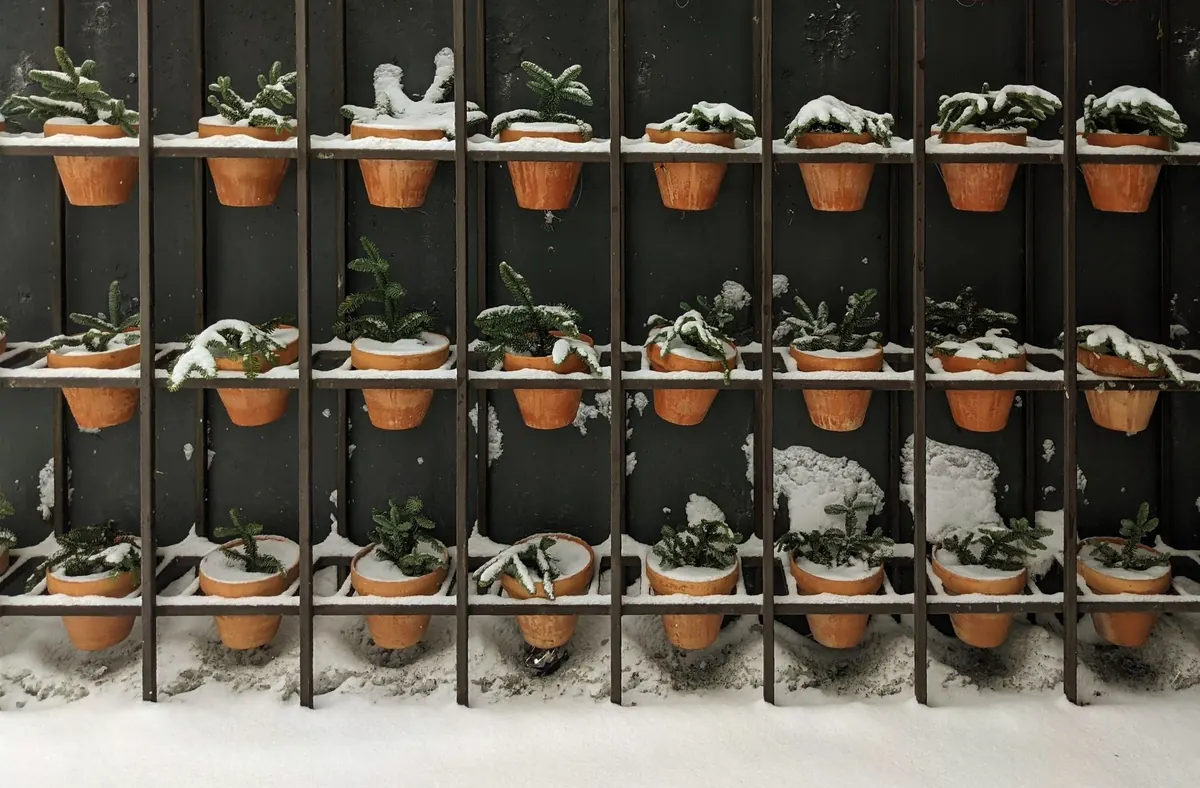
By the time the last annuals have gone over, most gardens are down to bare soil and wet leaves. Containers are the exception. A well-planted pot by the front door, on the patio or beside the kitchen window keeps its colour right through the grey months, and it gives you something to look at while the borders do nothing at all. The trick is not to fight winter, but to plant for it: structure, scent, evergreen foliage and a few small bulbs that will surprise you in February. Get the fundamentals right and your pots will ask very little of you until spring.
Get the drainage right before anything else
Most winter container failures are water problems, not cold ones. Roots sitting in sodden compost rot far faster than they freeze, and a pot that has spent December in a puddle is usually a pot you will be emptying in March.
Start with the holes. If your container has only one, or a hole that has silted up, clear it. The old advice about packing the base with broken crocks has largely fallen out of favour — a thick layer of rubble raises the water table inside the pot rather than draining it. A single piece of broken slate over the hole, or a square of fine mesh, is enough to stop compost washing out while letting water through.
For the compost itself, use a peat-free multipurpose mixed with roughly a quarter by volume of horticultural grit. If the pot is tall or in a windy spot, add some loam-based compost for weight and stability. Then lift the whole thing off the ground. Pot feet, bricks or three short lengths of timber do the job: they let air circulate underneath and give surplus water somewhere to go. Leave saucers off through the winter unless the pot is under cover.
Choose plants that earn their keep
Winter pots live or die on foliage. Flowers are a bonus, scent is a gift, but it is the leaves that carry you through to March. Look for plants with small, leathery or silvered leaves, which cope better with cold wind and wet than soft, lush growth.
- Skimmia japonica — tight clusters of red buds from autumn onwards, opening to scented flowers in spring.
- Sarcococca (Christmas box) — plain, glossy leaves and tiny flowers with a scent you can smell from the doorstep. Happy in shade.
- Hellebores — Helleborus niger for the earliest flowers, or the hybrid types for colour from January.
- Ivies and euonymus — trail over the rim and soften the edges of a hard pot.
- Small conifers, box, pittosporum or hebe — reliable structure. Trim lightly in spring to keep them dense.
- Winter heathers, cyclamen and violas — cheap colour that you can lift out and replace when it fades.
- Carex and other small grasses — movement in the barest months, and they shrug off frost.
Two or three good plants will always beat eight mediocre ones. A single clipped evergreen in a generous pot looks more deliberate than a crowd of straggly bits and pieces.
Planting a winter container, step by step
Autumn is the best time to plant, while the soil is still warm and roots can settle in before the cold arrives. Any dry, mild day from September to early November will do.
- Clean the pot, check the drainage hole and stand it on feet.
- Add a thin layer of grit or a single piece of slate over the hole.
- Half-fill with your compost and grit mix. Firm it gently — you want it settled, not compressed.
- Set the main plant slightly off centre rather than dead in the middle. Off-centre planting looks natural and gives the trailing plants room.
- Fill around it, then tuck in the smaller plants and any trailers near the rim.
- Plant a layer of small bulbs — crocus, Narcissus 'Tête-à-Tête', dwarf iris — about 10cm below the surface, underneath the shrubs. They will come up through the foliage before you expect them.
- Water well, then top-dress with grit or bark. This hides the compost, deters vine weevil and stops rain splashing soil onto the leaves.
Resist the urge to feed much. Growth is slow in winter, and soft new shoots are the first thing a sharp frost will burn.
Protecting pots from frost
Cold alone rarely kills a hardy plant in a container. What does the damage is the freeze-thaw cycle working on wet compost and on the pot itself. Terracotta is the most vulnerable: it is porous, holds water, and will flake or crack in a hard frost. Glazed, plastic and fibreglass pots are more forgiving, though the compost inside them still freezes.
Wrapping works. Two or three layers of bubble wrap, or a jacket of hessian tied with twine, insulates the rootball and the pot walls. Wrap the container, not the plant — the crown needs air, and a damp, sealed crown is an invitation to rot. In very cold spells, group pots together in a sheltered corner against a house wall, where they will benefit from residual warmth and protection from wind.
If the forecast turns severe, move smaller pots into an unheated greenhouse, garage or porch. They still need light, so bring them out again as soon as the worst has passed. Knock heavy snow off evergreens before it bends or snaps branches, and check that nothing is standing in a full saucer of water after a thaw.
Looking after them until spring
Winter containers are low maintenance, not no maintenance. Evergreens keep losing moisture through their leaves, and a pot against a wall may get almost no rain at all, so water sparingly on mild mornings when the compost feels dry a few centimetres down. Never water in the evening during a cold spell — wet compost overnight is the worst combination.
Deadhead violas and pansies to keep them going, pick off yellowing leaves before they turn to mush, and give each pot a quarter turn every few weeks so the plants grow evenly rather than leaning towards the light. If your pots sit near a road or drive, watch for splash from de-icing salt, which scorches foliage; move them back a little or rinse the leaves after a hard spell.
Keep one pot where you will actually see it
Plant more than you think you need, and plant it where it counts — beside the door you use every day, or on the path to the bins, not tucked away at the end of the garden where only the foxes will admire it. Bulbs planted in layers mean the same pot can carry you from November to April, and once the spring bulbs fade you can lift them, refresh the top few centimetres of compost and swap in something new. Refresh or replace the compost every couple of years, and a good container will reward you for a decade or more.
Photo: Guzel Sadykova / Pexels