


Pruning has a reputation problem. It sounds technical, and the wrong cut at the wrong moment can cost you a whole season of flowers — or leave a shrub looking as though it lost an argument with a hedge trimmer.
The reassuring part is that most timing questions answer themselves once you know one thing about the shrub in front of you: does it flower on wood it grew last year, or on growth it makes this season? Answer that and the calendar falls into place.
The one rule that explains most pruning dates
Shrubs fall into two broad camps, and the difference decides when you pick up the secateurs.
- Flowers on last year's wood: forsythia, lilac, philadelphus, weigela, deutzia, kerria, flowering currant, winter jasmine, choisya and spring-flowering ceanothus. Prune straight after flowering, ideally within two to four weeks. The plant then has the rest of the season to build next year's flowering shoots. Leave it until winter and you are simply cutting off the buds.
- Flowers on this year's wood: buddleja, caryopteris, perovskia, Hydrangea paniculata, Spiraea japonica, hardy fuchsia, hibiscus and lavatera. Prune in late winter or early spring, just as growth begins. Cutting these in autumn is not usually fatal, but it can push out soft shoots that frost will catch.
Everything else — evergreens, foliage shrubs, lavender, hedge plants — is mostly about shape rather than flowers, so timing is more forgiving.
How to make the cut
Cut just above a bud or a pair of buds, with the blade angled slightly away from it, using clean bypass secateurs. Choose a bud that points in the direction you want the new shoot to travel — usually outward, to keep the centre of the shrub open. Take stems back to a healthy side shoot or to the base rather than leaving a stub, because stubs die back and invite disease. Anything thicker than your thumb needs loppers or a pruning saw.
Spring: prune before growth starts, or wait until flowering ends
March is the busiest month in the pruning year. Buddleja davidii can be cut back hard to a low framework of around 60cm, and if the plant is well established you can go lower still; it will throw up long arching shoots carrying the biggest flower spikes. Cornus and salix grown for their winter stems get the same treatment, cut to the base in March just as the buds break, which gives the brightest colour the following winter.
Hydrangea paniculata and H. arborescens respond well to a hard cut in March, back to a permanent framework of two or three pairs of buds. Mophead and lacecap hydrangeas are gentler: remove the old flower heads and cut the flowering stems back to a strong pair of buds, then take out one or two of the oldest stems at ground level.
Spring-flowering shrubs are the opposite case — hands off. Let forsythia, flowering currant and kerria finish their display, then prune. In cold gardens and northern areas, delay cutting evergreens until late spring so fresh wounds are not exposed to a late frost.
Early summer: the post-flowering prune
From late May through July, the shrubs that flowered on old wood come into their own. Philadelphus, weigela, deutzia, lilac and choisya all want attention the moment the petals drop. Work through them in order as each finishes rather than saving the job for one weekend in autumn.
Cut back the stems that have just flowered to a strong young shoot lower down, then remove the oldest two or three stems at the base. That gap lets light into the middle and encourages replacement growth from the bottom, which is what keeps a shrub from turning into a bare-legged thicket with flowers only at the top.
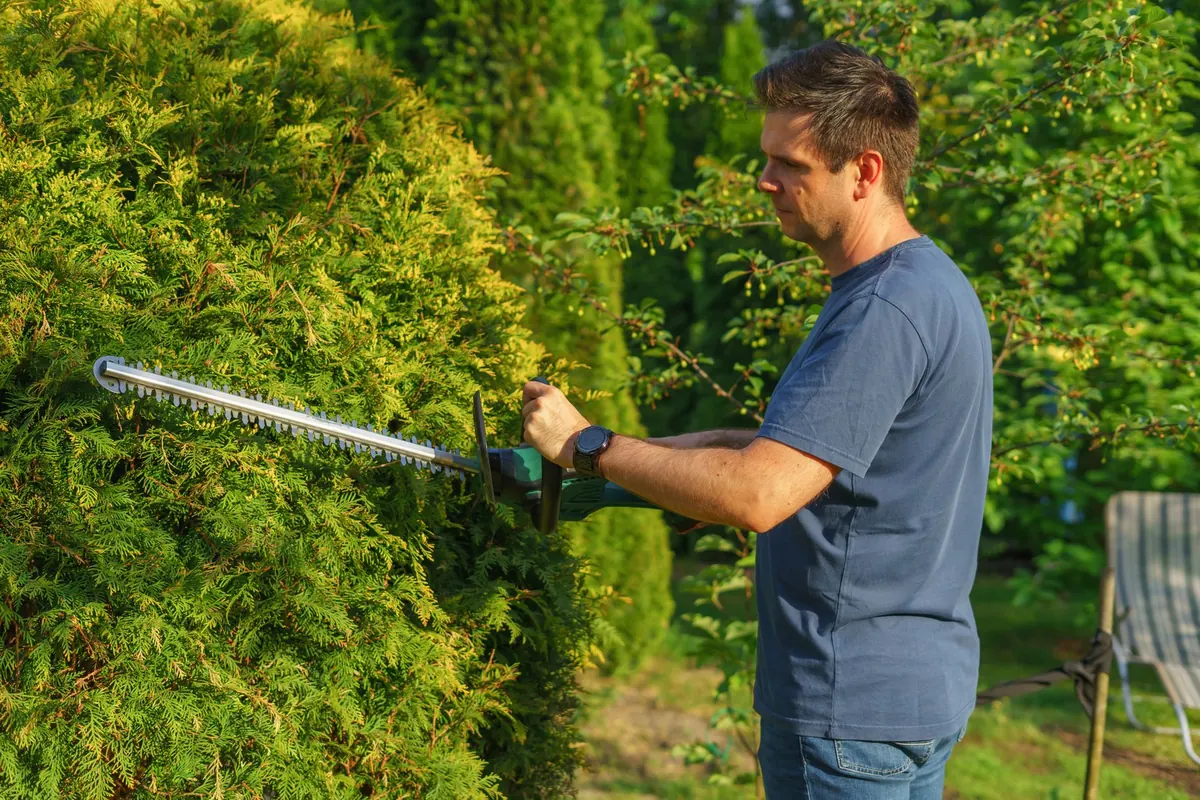
Resist the urge to run a hedge trimmer over them. Shearing leaves a dense outer shell and produces a mass of short, twiggy growth that flowers poorly the following year.
Late summer and autumn: shaping, evergreens and lavender
This is the window for trimming rather than renovating. Lavender, rosemary, santolina and hebe should be clipped as the flowers fade, taking the new growth back to a tidy shape but stopping short of the old, leafless wood — lavender will not reshoot from it. Box and other evergreen hedging can be cut now too.
Evergreens such as photinia, osmanthus, elaeagnus and laurel are best trimmed in late summer, so the regrowth has time to harden before winter. In colder parts of the country, finish by early September.
What to avoid is heavy pruning in autumn. Growth is slowing, wounds heal poorly, and a hard cut can encourage soft new shoots that the first frost will blacken. Only remove dead, damaged or diseased wood, and leave real structural work until the new year. Check any hedge or dense shrub for nesting birds before you start; active nests are protected, so if you find one, wait until the young have fledged.
Winter: structure, renovation and a few exceptions
From November to February, deciduous shrubs are dormant and their shape is visible. This is the time for removing congested branches, taking out the three Ds — dead, diseased and damaged wood — and planning a renovation. Work on a dry, mild day when the temperature is above freezing; frozen wood is brittle and splits badly.
Renovation suits most shrubs if you do it patiently. Over two or three years, take out a third of the oldest stems each winter, cutting them close to the ground. A few tough plants tolerate a single hard cut instead: buddleja, cornus, salix, hypericum and flowering currant will all regenerate from the base.
Two things to leave alone. Evergreens and tender shrubs should not be cut in midwinter, and spring-flowering shrubs should not be touched at all — winter jasmine, mahonia and witch hazel are pruned after they flower, not before.
A month-by-month calendar
- January–February: remove dead and damaged wood. Prune winter jasmine once it has finished. Plan renovation cuts.
- March: buddleja, Hydrangea paniculata, caryopteris, perovskia, Spiraea japonica, cornus and salix for coloured stems. Mophead hydrangeas. Last window for hard pruning before bud burst.
- April: finish summer-flowering shrubs. Tidy winter-damaged tips. Mulch after pruning.
- May: prune forsythia, flowering currant and kerria as they finish flowering.
- June: philadelphus, weigela, deutzia and lilac, straight after the flowers fade.
- July: choisya and any remaining spring-flowering evergreens. Light trim on hebe.
- August: lavender, rosemary, santolina, box and evergreen hedges. Finish by early September in cold areas.
- September–October: tidy only. Deadhead, remove dead wood, leave structure alone.
- November–December: sharpen and clean tools. Prune in mild spells if you must, but keep it light.
Getting into a rhythm
The easiest way to stay on top of pruning is to walk the garden once a week with secateurs in your pocket. Ten minutes of snipping as flowers fade beats a single exhausting session, and the plants look better for it. Keep your tools sharp, clean the blades between shrubs if you have been cutting anything diseased, and cut back to something — a bud, a side shoot, the base. Nothing else here is complicated, and after a season or two you will know your own shrubs well enough to ignore the calendar entirely.
Photo: Aleksander Dumała / Pexels